
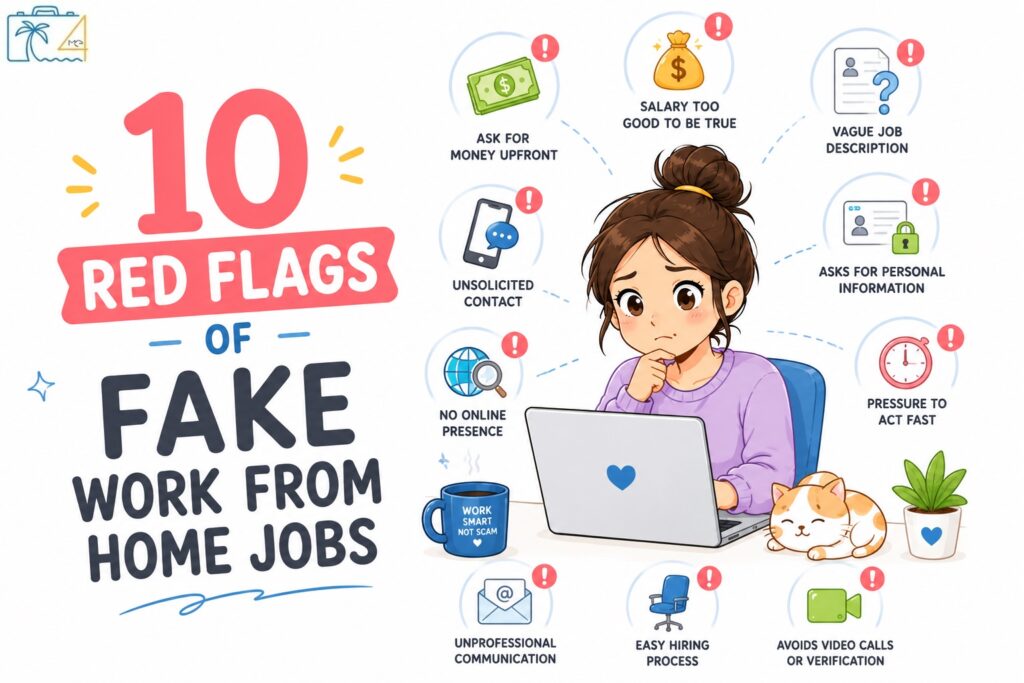
10 Red Flags of Fake Work From Home Jobs 🚨
Remote work is awesome.
No commuting.
No office politics.
No wasting two hours a day sitting in traffic.
Just you, your laptop, and the freedom to work from wherever you want.
The problem?
Scammers love remote work too.
Every day, people fall for fake work-from-home jobs that promise easy money, flexible hours, and a dream lifestyle. Some lose a few hundred dollars. Others lose their savings. Some hand over personal information that ends up in the wrong hands.
The good news is that most job scams are surprisingly easy to spot once you know what to look for.
Here are 10 red flags that should immediately put you on high alert.
1. They Ask You to Pay Money Upfront 💸
Let’s get the biggest red flag out of the way first.
If a company asks you to pay for:
- Training
- Software
- Registration
- Equipment
- Certification
- Processing fees
before you’ve even started working, walk away.
A real employer pays you.
You do not pay them.
Scammers often ask for small amounts because they know people are more likely to take the risk.
“It’s only $20.”
That’s exactly how they get people.
No legitimate job requires you to buy your way in.
2. The Salary Sounds Too Good to Be True 🤔
You’ve probably seen ads like these:
Earn $5,000 per month working 2 hours a day.
Make money from home with zero experience.
Guaranteed income. No skills required.
Sounds amazing.
That’s the problem.
Real companies talk about responsibilities, expectations, and qualifications.
Scammers talk almost exclusively about money.
If the job sounds like winning the lottery, it’s probably not a job.
It’s marketing.
Or worse.
3. The Job Description Tells You Almost Nothing 🚩
A legitimate job posting usually explains:
- What you’ll be doing
- Required skills
- Working hours
- Responsibilities
- Company information
A fake job posting often looks like this:
- Work from home
- Flexible hours
- Great pay
- Start immediately
That’s it.
No real details.
No actual job information.
If you can’t clearly understand what you’ll be doing every day, be careful.
A vague job description is often a sign that there isn’t a real job behind it.
4. A Recruiter Contacts You Out of Nowhere 📱
You never applied.
You never uploaded your resume.
You have never heard of the company.
Then suddenly you receive:
Congratulations! You’ve been selected.
Selected for what exactly?
Many scammers send the same message to thousands of people and wait to see who responds.
A random WhatsApp message should never be enough to convince you a job is real.
Always verify the company before continuing the conversation.
5. They Want Personal Information Immediately 🔒
Be careful if someone asks for:
- Bank account details
- Goverment issued id card number
- Credit card information
during the first conversation.
A legitimate company may eventually need certain documents.
But asking for sensitive information before an interview is a major warning sign.
Your personal information is valuable.
Treat it that way.
6. The Company Barely Exists Online 🌐
Before accepting any offer, do five minutes of research.
Check for:
- An official website
- A LinkedIn page
- Employee profiles
- Reviews
- Business information
If you can’t find anything, that’s a problem.
Real companies leave digital footprints.
Fake companies leave excuses.
7. They Pressure You to Decide Right Now ⏰
Scammers love urgency.
You’ll hear things like:
Offer expires today.
Limited openings available.
Pay now to secure your position.
Respond within one hour.
Why the rush?
Because they don’t want you thinking.
They don’t want you researching.
And they definitely don’t want you asking questions.
Real employers want qualified candidates.
Scammers want quick decisions.
Never let anyone rush you into a job offer.
8. Their Communication Looks Unprofessional 📧
Pay attention to the little things.
Examples:
- Poor grammar
- Strange email addresses
- Random WhatsApp numbers
- Generic greetings
- Copy-paste messages
One mistake isn’t a big deal.
Five different warning signs usually are.
Professional companies tend to communicate professionally.
Scammers usually don’t.
9. The Interview Is Suspiciously Easy 🎭
You apply.
Five minutes later you’re hired.
No interview.
No questions.
No assessment.
No discussion about your experience.
Sounds great, right?
Not really.
Good companies care who they hire.
Scammers care who they can scam.
If there is no real hiring process, that’s a red flag.
10. They Avoid Video Calls or Verification 🚨
A legitimate employer can usually provide:
- Official email communication
- Video interviews
- Company website
- Employee profiles
- Verifiable business details
Scammers often avoid anything that can confirm who they are.
If someone refuses basic verification, trust your instincts.
A real company has nothing to hide.
Quick Rule: One Red Flag Is Fine. Five Red Flags Aren’t.
Not every warning sign automatically means a scam.
But when multiple red flags appear together, pay attention.
Research the company.
Ask questions.
Verify everything.
And never send money.
There will always be another opportunity.
Frequently Asked Questions
How can I identify fake work-from-home jobs?
Look for warning signs such as upfront payments, unrealistic salaries, vague job descriptions, poor communication, and missing company information.
Are legitimate remote jobs free to apply for?
Yes. Legitimate employers do not charge candidates money to apply, interview, or get hired.
Why are remote job scams becoming more common?
Remote work is more popular than ever, which makes it easier for scammers to target job seekers looking for flexible opportunities.
Final Thoughts
The remote job market is full of genuine opportunities.
But it’s also full of people trying to take advantage of hopeful job seekers.
Do your research.
Verify every company.
Ask questions.
Trust your instincts.
The best remote jobs don’t ask for money.
They don’t pressure you.
And they don’t hide who they are.
Remember this:
A legitimate employer wants your skills.
A scammer wants your money.
Know the difference.
Get remote job alerts directly on your phone
Join thousands of remote workers for daily updates.